Letter from Board Chair Inye Wokoma and Director Michael Woo

Earth Day 2013
Dear Got Green Supporter,

One of our volunteer writers asked Vernon Hill a pivotal question in community organizing – “Why, when it’s so easy to hang back, have you stepped forward to lead?”

“I do it because I want to come forth myself and speak up for what’s right,” Vernon told us. “But I really do it so that others feel they can come forth too.”

Vernon Hill, grassroots leader in Got Green’s South Seattle Jobs Committee, hit the nail on the head. His real reason for leading isn’t because he wants to put himself out in front of his community; it’s because he wants to pave the way for more people in his community to lead.

Tammy Nguyen, founder and organizer of our Women in the Green Economy Project/Food Access Team often frames the alternative to community organizing and leading as “getting left behind.” In describing her evolution from single teen parent to community leader, she says simply, “I did not want my family, neighbors and communities to be left behind again. I wanted us on the front end of this movement for a new, green economy. Not sitting on the side of the freeway watching it pass us by.”

Emerging Leader Profile: Violet Lavatai, ‘Putting my community first’

Inspirational. Heartfelt. Passionate. Giving. Caring. Compassionate. Selfless.

These are words that I use to describe Violet and her story, which I was fortunate to hear on a rainy afternoon, over coffee and donuts at King’s Donut Shop off Rainier. Violet, Healthy Food Access Team member, seemingly overnight, became one of Got Green’s most vocal emerging leaders.

Food Access Leader Violet Lavatai

“It changed everything, that survey. My life did a 180.” 

As someone who met Violet during the summer of last year, I can attest to her tremendous growth and contributions to Got Green.   Violet came to Got Green through the Women In the Green Economy Project. She lost her job running gas stations and, like many others, was forced to live with family.

Violet and her son Russell moved from Des Moines to Seattle to rent a room in her sister’s house. While shopping at a local grocery store, a Got Green interviewer approached her. Violet remembers, “She said, ‘Let me buy you a cup of coffee.’ See, that works. She asked me questions about myself and what was important.”

At first, Violet wasn’t sure what to make of Got Green, but after attending a few meetings, her perceptions began to change. ‘I always thought about my family but not my community…I started to think less of myself.’

Within the past year, Violet went from someone who didn’t have any public speaking experience, to approaching legislators at the state’s capitol. Last year she also empowered 36 women, who had never voted, to participate in the 2012 elections.

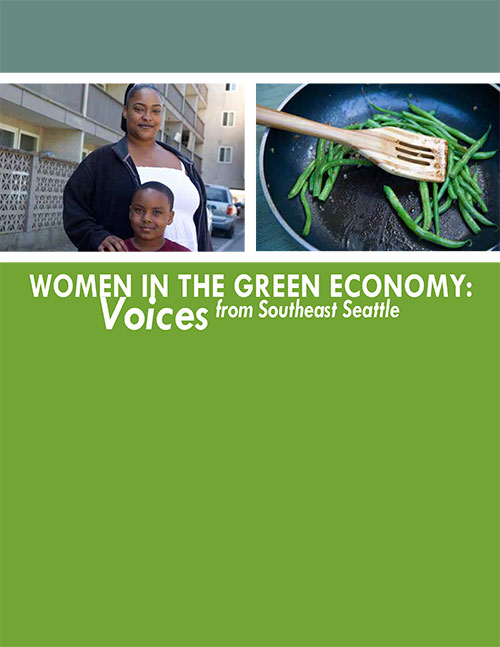
Women in the Green Economy/Food Access Team’s organizing puts fresh, local produce back on low income families’ tables

The Healthy Food Access Team made great progress in 2012. Last year was the mark of empowerment and emerging leaders. In the pursuit of food justice, for low income women and women of color, the Team took to the steps of the State legislature and embarked on a mission to save the Farmers Market Nutrition…

Emerging Leader Profile: Sintayehu Tekle, ‘Refusing to Be a Statistic’

For Sintayehu Tekle, Got Green represents one simple thing: Hope. Sintayehu’s is a classic story of overcoming a negative environment, language barriers, and the influence of gangs to build a future – not only for himself, but for his community. He went from being an unemployed immigrant from a third world country to sitting on…

Emerging Leader Profile: Khalil Panni, ‘It Just Feels Good to Make a Difference’

Family is the bedrock of our society, the fabric upon which our society is formed. As the proverb goes, it takes a village to raise a child. Khalil Panni grew up with a strong extended family that shaped his sense of community.  A Seattle native, the current member of the Board of Directors struggled to…

Emerging Leader Profile: Vernon Hill, ‘Helping others step forth’

Vernon Hill, a Got Green grassroots leader, enjoys working with his hands.  He has worked in construction, maintenance, and aerospace industries, and has his AA in Construction Management. This past year, Vernon combined his construction work experience with his deep commitment to community and racial justice.  He has since been a strong community voice for…

South Seattle Jobs Committee: City development needs to create jobs for our community!

“Our power is greatest when the debate about jobs is happening in the public eye.” – Michael Woo, Organizer and Got Green Director Wielding signs that read, “What, no local hire?”, “If you work here, hire here” and “Do the right thing, hire locally,” members of Got Green’s South Seattle Jobs Committee picketed the Rainier…

2011 Organizing Report – Putting Women’s Voice Front and Center in the Green Economy

“This project represents a voice that doesn’t get lifted up; it represents a perspective that needs to get heard,” said Got Green board member Theresa Fujiwara at the launch of the new Women in the Green Economy Project last January. Lillie Brinker, expanded on this idea when she said “It’s time for low income women…

2011 Organizing Report – Ed Mayer: “It’s our job to make sure no one is left behind”

“The Recession hit me hard,” said Ed Mayer, who worked steadily as a journey level construction worker out of the Laborers Union Local 440 before the economy tanked. Living much of his adult life in the Puget Sound, Ed reaches out to young people about the importance of being active in their community and fighting…

2011 Organizing Report – Letter from Director Michael Woo

April 9, 2012 Dear Got Green Supporter: When we formed Got Green in 2008, talk about climate change, global warming and saving the planet was all around us. One message really resonated with me: get on board with the new, green economy or get left behind. I remembered back to 1971 when as a young,…

2011 Organizing Report – Organizing for a Green Solution to Unemployment in Communities of Color

When the Green Jobs Act was passed by Congress in 2007, and then later funded through the 2009 American Reinvestment and Recovery Act (ARRA), dozens of training programs were established to help address job shortages in low income communities and meet the need in green industries – like energy efficient building construction, renewable electric power,…